Quick answer: what is multimodal search? Multimodal search lets you search with more than typed words. You can point your camera at something, speak a question, or combine a photo with text, and an AI system understands all of it together. Instead of a list of links, you get a direct answer based on what you showed and said. Google’s Search Live, which expanded to more than 200 countries in March 2026, is one example.
You’ve been there. You type “thing that holds cables on desk” and hope the search engine works out that you mean a cable clip. Three tries and a dozen useless results later, you finally find it.
For more than twenty years, that’s how search has worked. Traditional search is a “pull” system: you have to know what you’re looking for and how to describe it. You become the translator between what’s in your head and what the machine understands.

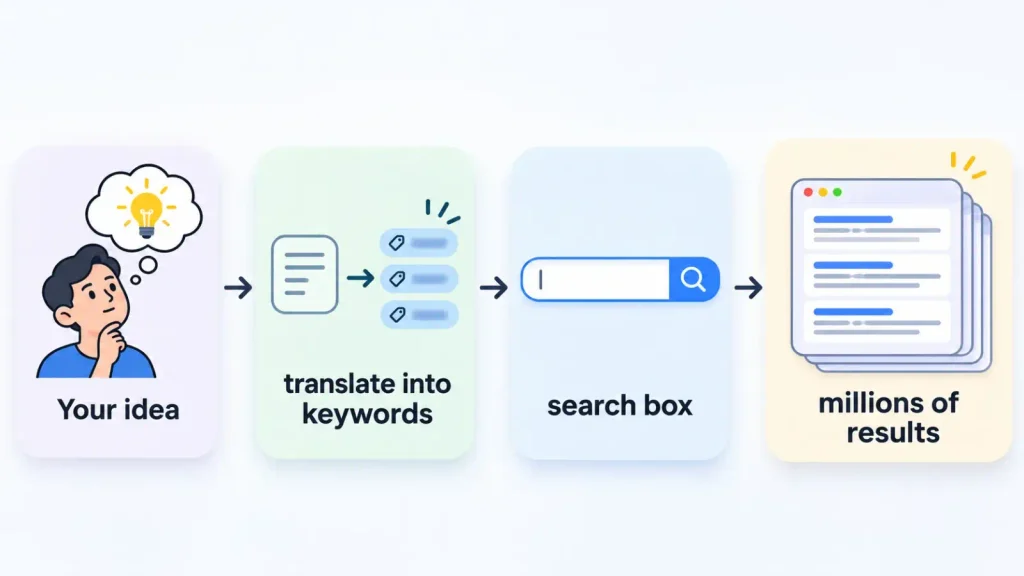
From pull to push: how multimodal AI changes discovery
Multimodal AI is artificial intelligence that can understand text, images, audio and video together. It flips the old model around. You don’t have to find the right words; you show and tell, and the system works out what you need.
That’s why many people think the search bar’s days as the main way in are numbered. In February 2024, Gartner predicted that traditional search engine volume would drop 25% by 2026, as AI chatbots and virtual agents become “substitute answer engines.” Whether or not that exact number holds, the direction is clear.
What Is Multimodal Search, and How Does It Work?
Multimodal search combines several kinds of input, such as camera, voice and text, into one query. The AI uses all of them at once to understand your situation, not just your words.
A real example: the broken dishwasher
Picture yourself in front of a dishwasher that won’t work.
- With traditional search: You find the brand and model number, describe the problem in text, and hope someone on a forum had the same issue.
- With multimodal AI search: You point your phone at the dishwasher and say, “It makes a grinding noise when the wash cycle starts.” The AI sees the model, hears the symptom, and suggests likely causes and fixes.
This is already here. Google’s Search Live lets you open the Google app, tap the Live icon, point your camera at something and talk with Search about what it sees. It launched in the US in 2025 and, on 26 March 2026, expanded to more than 200 countries and territories, everywhere Google’s AI Mode is available.


Traditional search vs. multimodal AI search
The big difference is context. Old-style search treats every query on its own. Multimodal search treats it as part of a conversation and uses what it can see and hear.
| Feature | Traditional search | Multimodal AI search |
|---|---|---|
| Input | Typed keywords | Text, voice, images and video |
| How it understands you | Matches words | Interprets meaning and intent |
| Output | A list of links | A direct, synthesized answer |
| Context | Very little | What you’re looking at and asking about |
| Effort | High: you need the right words | Low: show it, say it, or describe it |
| Follow-ups | Start a new search | Continue the conversation |
The technology behind it: semantic search and vector databases
Two ideas make multimodal search possible: semantic search and vector databases.
Keyword search looks for the exact words you typed. Semantic search turns your query into an embedding, a long list of numbers that represents its meaning. A vector database then finds the stored items whose embeddings are closest, so it can match ideas even when the words differ. A search for “how to fix a looping error” can find an article titled “debugging infinite loops.”
The same trick works beyond text. Modern models can turn images, audio and video into embeddings in a shared space. That’s how an app can take a photo of a plant and return its species, care tips and where to buy one.
Businesses are investing accordingly. MarketsandMarkets estimates the vector database market will grow from $2.65 billion in 2025 to $8.95 billion by 2030, a 27.5% compound annual growth rate.
From Millions of Links to One Clear Answer
Multimodal AI search solves information overload by doing the reading for you. Instead of handing you a pile of links, it pulls from several sources and gives you one answer that fits your situation.
The problem: too many results, not enough answers
Search for “best laptop for graphic design” and you’ll get pages of results. You open ten tabs, skim five reviews and still aren’t sure which one fits your budget or your software. Psychologist Barry Schwartz called this the paradox of choice: more options often make decisions harder, not easier.
The fix: AI as your research assistant
Multimodal AI acts more like a curator than a library. It’s the difference between being handed fifty books and having an assistant read them and give you a two-page summary. You still get sources to check, but the first job, narrowing things down, is done for you.
Examples of multimodal discovery in action
- Visual search: Snap a photo of a dish at a restaurant to find a similar recipe, or photograph a chair to find where to buy it. Your camera becomes the search bar.
- Voice search on the go: While driving, ask your car’s assistant, “What are the main trends in renewable energy this quarter?” and hear a spoken summary without touching a screen.
- Problem solving across formats: A mechanic photographs a corroded part. The AI identifies it, suggests compatible replacements and points to relevant service notes.
How Multimodal Search Is Playing Out in the US and Europe
In the US, the shift is driven by how people already search; in Europe, it’s shaped just as much by privacy law.
United States: from social discovery to AI discovery
The ground was moving before multimodal AI arrived. Many younger Americans already look for answers on TikTok, Instagram and YouTube, choosing short videos over pages of text. Google still dominates search overall, but people now spread their questions across several platforms.
Multimodal AI search is the next step in that habit. It gives people the visual, conversational answers they’ve come to expect from social video, with the breadth of a search engine.
Europe: privacy and the EU AI Act
When your camera and microphone become search tools, the question of what happens to that data matters more. Two sets of rules shape this in Europe.
The GDPR already governs personal data such as photos and voice recordings. The EU AI Act, in force since 1 August 2024, adds rules for AI systems based on their level of risk. Its timeline changed in July 2026, when the Digital Omnibus on AI took effect:
| AI Act milestone | Date |
|---|---|
| Bans on prohibited AI practices | 2 February 2025 |
| Rules for general-purpose AI models | 2 August 2025 |
| Most transparency duties, such as telling people they’re talking to an AI | 2 August 2026 |
| Labelling of AI-generated content | 2 December 2026 |
| High-risk AI systems (for example hiring and credit scoring) | 2 December 2027 |
| High-risk AI built into regulated products | 2 August 2028 |
One practical response is on-device AI: processing camera and voice data on the phone itself instead of sending it to the cloud. Apple, Google and chipmakers like Qualcomm are all pushing in this direction. It doesn’t make a product compliant on its own, but keeping data on the device is a strong privacy-by-design choice that reduces what can leak or be misused.
What Multimodal Search Means for Businesses and SEO
For businesses, multimodal search saves time on internal work and changes how customers find you. Both are worth planning for now.
Productivity: from 30 minutes to under a minute
Take a supply chain manager checking a part from an overseas supplier. The old way: search the catalogue, download the PDF, find the part number and compare it with internal documents. That can take 20 to 30 minutes.
With multimodal AI, they photograph the label and ask, “Does this match the specs on our approved parts list?” If the AI is connected to that list, the answer can come back in under a minute. Repeat that across a company and the hours add up quickly.
Apps without a search bar
A new wave of apps barely needs a search box. They use AI, often running on the device’s own neural processing unit (NPU), to bring up what you need before you ask:
- Project management tools that show the right documents for each task.
- Design apps that suggest colour palettes based on what’s on the canvas.
- Field service apps that identify equipment from a photo and load its maintenance history.
How to optimize content for multimodal AI search
SEO doesn’t disappear; it widens. To show up when people search with a camera or their voice:
- Structure content so AI can read it. Use clear, question-style headings, short answer-first paragraphs, schema markup and tables.
- Treat images as content. Use original, high-quality product photos with descriptive file names and alt text, and keep your Google Business Profile up to date so you appear in camera-based and local searches.
- Write for spoken questions. Voice queries are longer and more conversational, so answer full questions in plain language.
- Build your brand as an entity. Keep your name, description and details consistent across your website, social profiles and review sites. AI search tools cite sources they trust, so authority matters more than keyword density.
The Future of Search: A World Without Boxes
The search bar was the best tool we had when computers couldn’t see, hear or understand context. That’s no longer true. With multimodal AI, the machine adapts to us: it hears what we say, sees what our camera sees, and understands the situation around a question.
The future of search is less about finding information and more about information finding you when you need it. The businesses that prepare their content, images and brand for that shift now will be the ones these new tools recommend.
Frequently Asked Questions (FAQ)
What is multimodal search?
Multimodal search lets you search using more than one kind of input, such as text, voice, photos or live video. An AI system understands them together and gives you a direct answer instead of a list of links.
How is multimodal search different from traditional search?
Traditional search matches the words you type. Multimodal search understands meaning and context from what you show and say, keeps track of follow-up questions, and returns a synthesized answer.
Can I use multimodal AI search today?
Yes. Google’s Search Live lets you point your phone camera at something and talk with Search about it. It expanded to more than 200 countries and territories in March 2026. Google Lens and AI assistants with camera and voice input work in similar ways.
How do I optimize my website for multimodal search?
Use clear, question-style headings and short answer-first paragraphs, add schema markup, and use original images with descriptive alt text. Keep your business details consistent across your website, social profiles and review sites so AI tools recognize your brand.
Will multimodal AI replace the search bar completely?
Not entirely, at least not soon. Typing is still the fastest option for many simple questions. But camera and voice search are taking over tasks where describing something in words is hard, and AI answers are replacing many clicks on blue links.